

Stainless Steel Rope Ferrule Mesh: Strength at Every Crimp
What a ferrule actually does in rope mesh
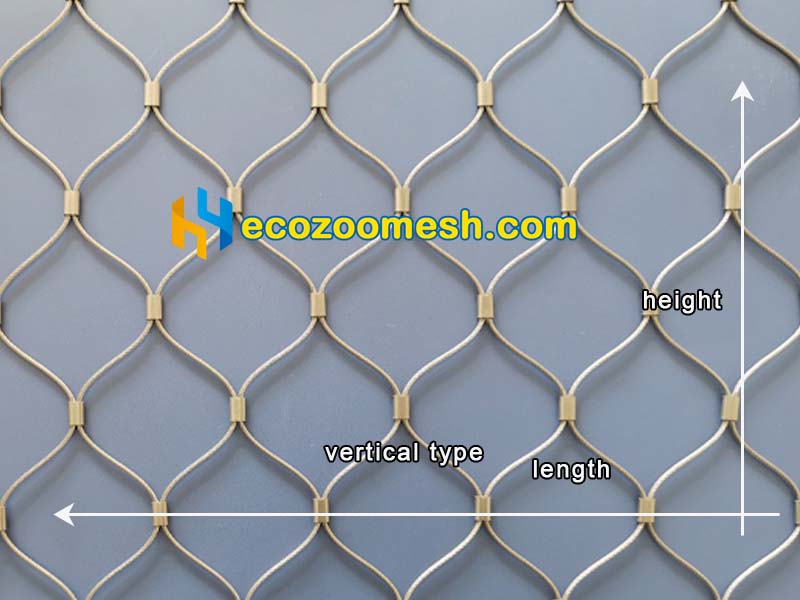
Stainless steel rope ferrule mesh is built from stainless steel wire rope that is formed into a net, with a small metal sleeve — the ferrule — crimped over every crossing. The sleeve is pressed onto the rope with a machine, so each crossing is locked into a fixed position instead of being free to move.
There is one thing to understand about a ferruled net, and it is the ferrule. It is not decoration. It is the part that holds the net together, sets how stiff the sheet feels, and decides how much load each crossing can carry.
That is why "ferrule" is not a marketing word. It is a manufacturing spec. The ferrule size, the rope diameter, and the crimp quality are the details that decide how the sheet performs — and those are exactly the details a supplier should be able to document.

What the ferrule decides about the sheet
A rope mesh net lives or dies at its crossings. Under load, the sheet transfers force from strand to strand through those points. The ferrule makes each transfer possible, so it quietly sets four things.
- Rigidity. A crimped sleeve does not let the strands rotate, so the sheet holds its shape instead of sagging or springing back.
- Strength. The ferrule carries load from one strand to the next; its size and crimp quality set how much it can take.
- Surface. Sleeves sit at every crossing, giving the mesh a regular, engineered feel.
- Appearance. Evenly spaced sleeves produce a precise, uniform pattern — a design feature in architectural work.
Get the ferrule right and the sheet behaves predictably. Get it wrong — a sleeve mismatched to the rope — and the crossing is the first thing to fail.
 |
 |
Why projects specify the ferrule type
A rigid sheet that holds its plane
A crimped ferrule does not let the strands rotate. The result is a stiff sheet that keeps its shape instead of sagging or springing back. On balustrades, screens, and large facade panels, that rigidity is the whole point — the mesh reads as a stable surface, not a slack net.
Repeatable, machine-set strength
Each ferrule is pressed to the same specification, so per-crossing strength is consistent across the panel and from order to order. For projects that need a documented, predictable load path, that consistency is exactly what the design calls for.
A clean, engineered look
Sleeves sit at regular spacing and give the mesh an even, precise pattern. In architectural work — where the mesh is seen up close and in bright daylight — that regularity is a design feature.
Production that scales
Ferruling is a machine-controlled step, so large orders can be produced with tight tolerances and dependable lead time. That matters when a project has a fixed installation date.
Wire grades and finishes that survive the weather
The sheet is only as good as the rope. For outdoor and wet installations, the wire grade is the difference between a decade and a generation.
- 304 stainless steel — the standard indoor and inland outdoor choice. Strong corrosion resistance for normal climates.
- 316 stainless steel — adds molybdenum, which resists chlorides. The default for coastal sites, swimming pools, and marine air.
- 316L stainless steel — a low-carbon grade that resists sensitization, used where welding or aggressive exposure is expected.
Finish matters just as much. A bright natural finish reflects light and suits architectural work. A black finish (black oxide or a coated variant) reduces glare, blends into dark backgrounds, and is a common ask for zoo and aviary projects. Because these are surface treatments, they must be judged on how they age under UV and salt — ask your supplier for the exact finish and expected life, not just the color.
Specifications that set real strength
Marketing photos hide the numbers. These are the parameters that decide how a ferruled net performs.
Breaking load is a test result, not a brochure number. Rope construction, ferrule size, and crimp quality all change it. Always ask for a test report for the exact rope diameter and opening you are ordering, and match it to your load case — wind, animal impact, and people.
Where stainless steel rope ferrule mesh performs best
- Architectural facades and screens — a rigid, even sheet that holds a flat plane.
- Balustrade and staircase infill — deflection stays low under a leaning load.
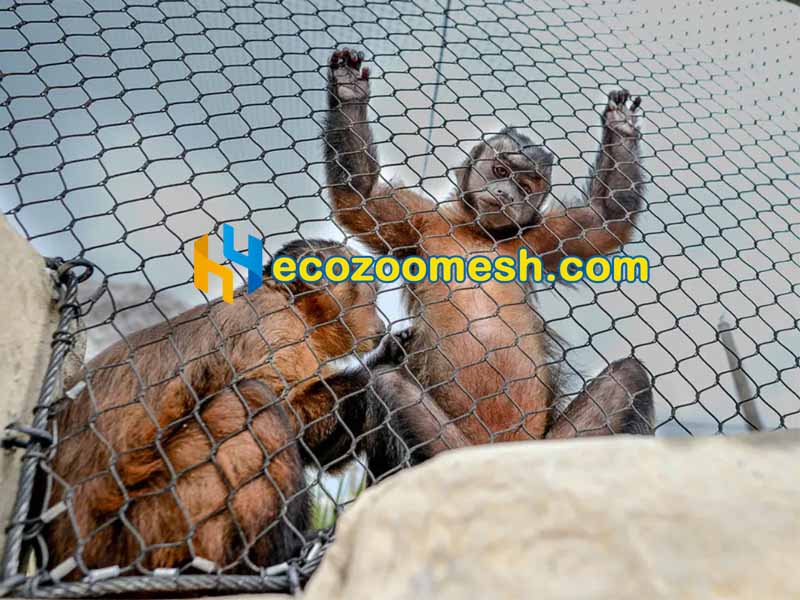
- Zoo and wildlife enclosures — a strong, uniform barrier with a documented load path.
- Aviaries and bird flight cages — precise openings and a clean, regular look.
- Safety and fall-protection netting — repeatable strength at every crossing.
- Green walls and climbing-plant frames — a firm grid that holds shape under growth.
Where a fixed, rigid, precisely spaced mesh is required, the ferruled type is hard to beat.
Specifying mistakes to avoid
- Mismatching the ferrule to the rope. A sleeve sized for the wrong diameter is the most common cause of joint failure.
- Choosing by opening alone. Rope diameter, grade, and ferrule size change strength and cost far more than opening does.
- Guessing the wire grade. Inland projects can use 304; coastal and pool projects should not.
- Ignoring the finish life. Black is not one thing — confirm how the finish is produced and how it ages.
- No test report. A number without a document is not a specification.
Installation notes that protect the crimps
A ferruled sheet arrives ready to fit, but the frame and tension still decide how it performs.
- Frame first. A rigid perimeter frame keeps the sheet in plane and spreads load evenly.
- Tension evenly, corner to corner. Uneven tension can distort the ferrule grid.
- Respect the edge rope. Edge ropes and fixings should be sized to match the rope diameter.
- Leave a service margin. Plan how a damaged panel would be replaced before you install.
FAQ
What sets the strength of ferrule rope mesh? The ferrule size and crimp quality, the rope diameter, and the rope construction. Because every ferrule is machine-set to the same spec, per-crossing strength is consistent across the panel — always confirm with a test report for your exact build.
Does stainless steel rope ferrule mesh rust? Stainless grades resist rust, not stain. 316 and 316L handle coastal and chloride exposure well; 304 is better suited to inland conditions. Finish and cleaning also affect appearance over time.
Can a ferruled net be repaired? A damaged crossing normally calls for a replacement ferrule or a new panel. Plan access and spare panels before installation so a repair never becomes a rebuild.
Which opening should I choose? Match the opening to what must be kept in or out. Smaller animals and birds need smaller openings; larger openings save cost and weight when containment is not tight.
Choosing a supplier for stainless steel rope ferrule mesh
Ask four questions: which wire grade, which finish and its expected life, the ferrule size matched to your rope, and the test report for your exact rope and opening. A supplier who answers all four without hesitation is the one worth keeping.
Need stainless steel rope ferrule mesh for a project? Send us your opening, rope diameter, wire grade, and panel size — we will return a specification and a test-backed quote.